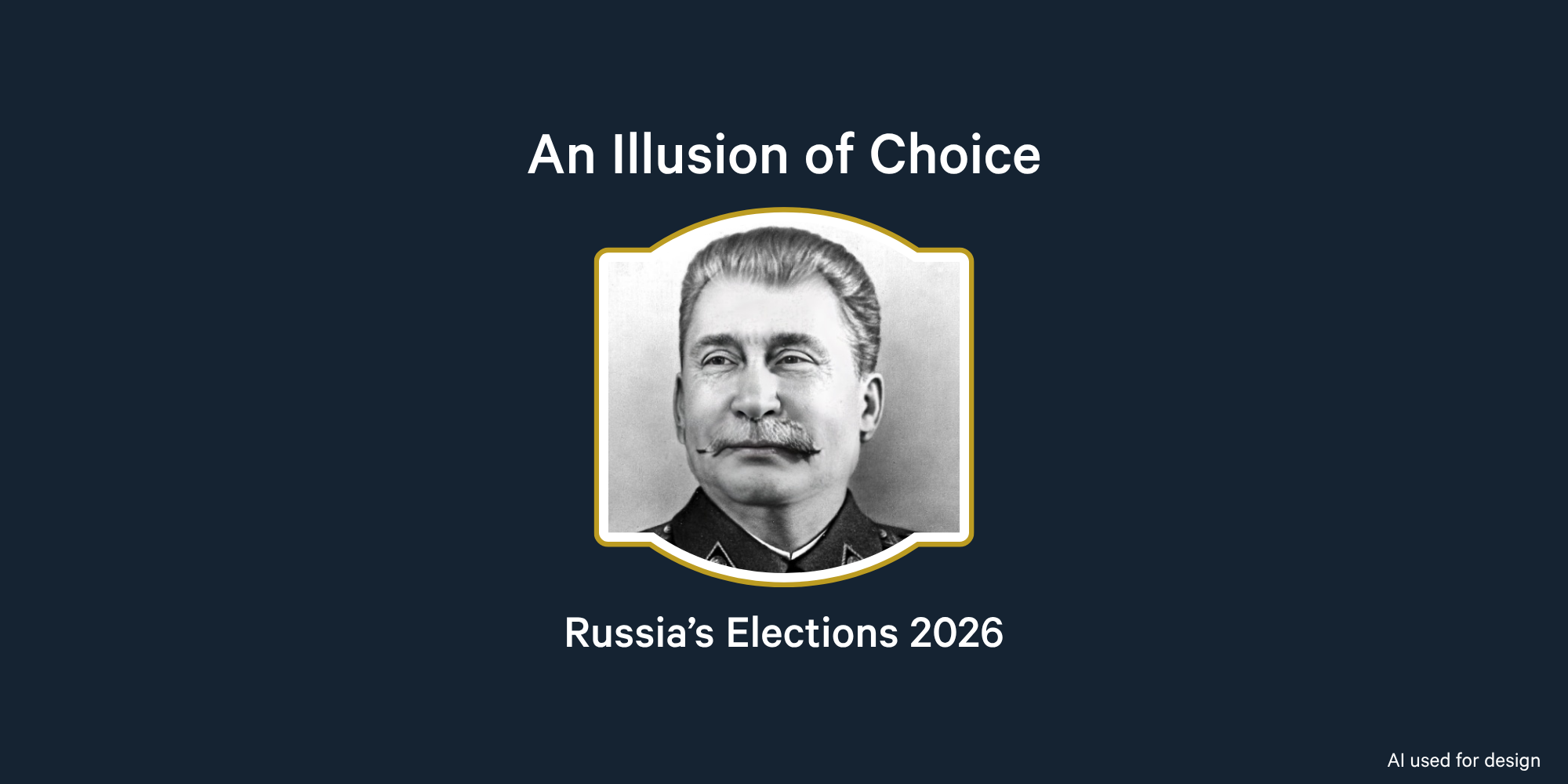
Russia holds parliamentary elections from 18 to 20 September 2026. They will take place during the fifth year of Russia’s full-scale war against Ukraine, in a context marked by extensive political repression, thousands of Ukrainian civilian deaths and politically motivated detentions in Russia, expanded wartime restrictions, severe international sanctions, and significant military losses. According to experts, Russia has around one million casualties, whereof 400 000 deaths. OVD info, Russia’s leading human rights organisation, which monitors political prosecutions, was labelled as “an extremist” and “terrorist” organisation in the beginning of June 2026.
Various independent sociological research suggests that Russian society is increasingly fatigued by the war, while deteriorating socioeconomic conditions are affecting everyday life. As the conflict continues, its consequences are becoming more visible within Russian society, reaching beyond the battlefield and into the daily lives of ordinary citizens.
Many appear to be expressing growing frustration with the costs of the war, while remaining broadly supportive of the political system that enabled it. How do these citizens perceive the current situation? Why have Russia’s political elites continued to pursue the war despite its mounting costs? And how can Russian society express disagreement when independent political activity, public protest, and dissent are criminalised and subject to severe legal restrictions and repression?
To answer these questions, the Norwegian Helsinki Committee and PEN Norway have invited Alexandra Prokopenko, sociologist and researcher of Russian economic policy, and Leonid Drabkin, the head of OVD-Info.
Program:
16:30 Coffee and registration
17:00 Welcome – Jørgen Watne Frydnes, PEN Norway
17:05 Co-perpetrators: Russian elites and war economy – Alexandra Prokopenko
17:15 Martial laws and repressions – how to resist? – Leonid Drabkin, OVD info
17:25 Berit Lindeman, Secretary General of the Norwegian Helsinki Committee, in conversation with Alexander Prokopenko and Leonid Drabkin
18:00 End
About the speakers:
Alexandra Prokopenko is a fellow at the Carnegie Russia Eurasia Center. In her research, she focuses on Russian government policymaking on economic and financial issues.
From 2017 until early 2022 Alexandra worked at the Central Bank of Russia and at the Higher School of Economics (HSE) in Moscow. She is a former columnist for Vedomosti. She is a graduate of Moscow State University and holds an MA in Sociology from the University of Manchester.
Alexandra was a visiting fellow at the Center for Order and Governance in Eastern Europe, Russia, and Central Asia at the German Council on Foreign Relations (DGAP).
She is the author of From Sovereigns to Servants. How the War Against Ukraine Reshaped Russia’s Elite (London, 2026).
Leonid Drabkin is a senior executive with extensive experience leading OVD-Info, one of Russia’s largest and most respected human rights organisations, where he focused on documenting political prosecutions and providing legal support.
Drabkin holds an MSc in Finance from the United Kingdom and is recognised for a results-driven, change-oriented approach to advancing human rights. He was named to Forbes 30 Under 30 and is currently working in exile following Russia’s invasion of Ukraine.