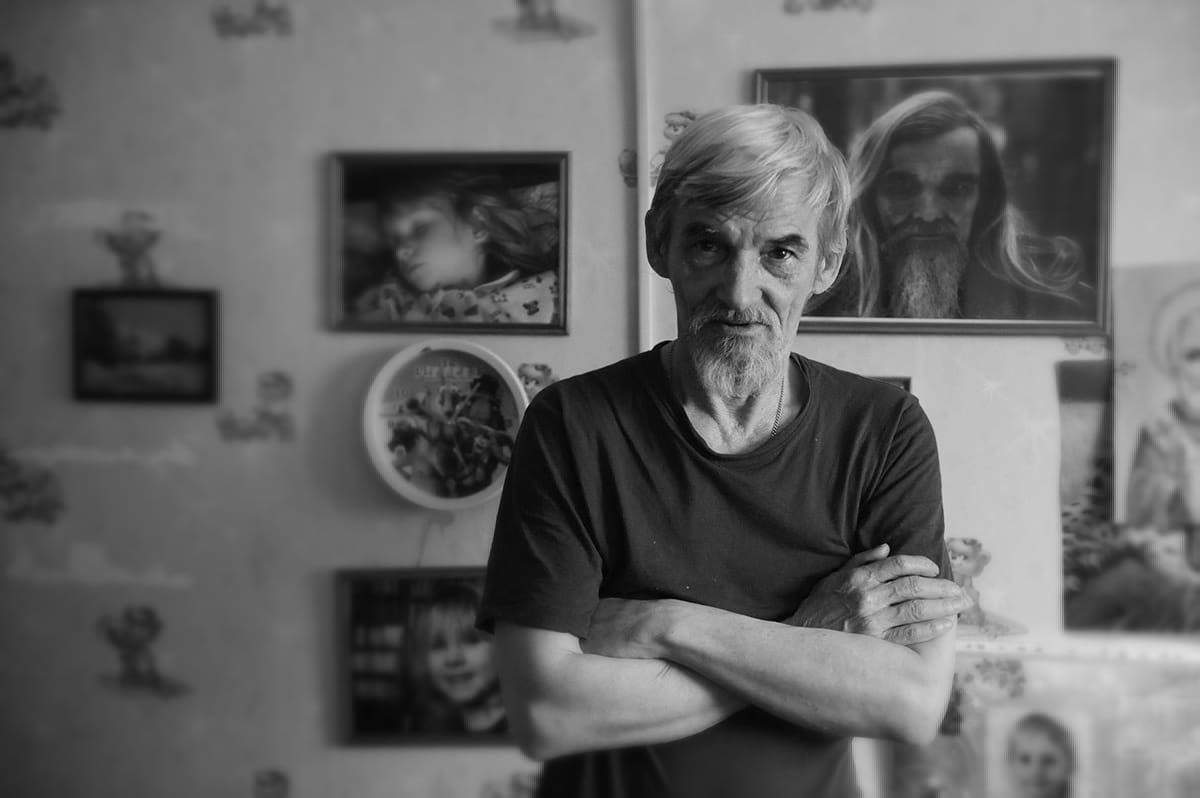
This is the situation of Yuri Dmitriev, one of the first political prisoners of the current wave of Putin’s repressions. Arrested in December 2016 on false charges, he has been in prison for more than nine years. On January 28, 2026, he will turn 70. He will spend this birthday in a maximum security penal colony in Mordovia. Several chronic illnesses have become seriously exacerbated during this time. Instead of receiving treatment, Dmitriev is regularly punished for feeling unwell: he has been placed in solitary confinement several times for sitting down on his bed during the day or not performing his morning exercises sufficiently actively. Despite suspected cancer, Dmitriev has been denied diagnostic tests for three years. According to his sentence, he must remain in custody for another six years. However, the delay in providing competent medical care may soon prove fatal.
The reason for the criminal case against Yuri Dmitriev was his work researching the history of Stalinist terror in Karelia in northern Russia and preserving the memory of its victims. Dmitriev headed the Karelian branch of the Russian Memorial Society. He spent thirty years searching for the burial sites of victims of the Great Terror, examining archival data to reconstruct the fates of those who were killed. Thanks to his efforts, numerous memorial sites commemorating the crimes of the Stalinist regime were created, including the Sandarmokh memorial complex, one of the most famous sites of executions dating back to 1937–1938. He reconstructed the biographies of thousands of victims, including more than a hundred figures of the so-called Executed Renaissance of Ukraine, writers, poets, and theater directors. In 2014, Yuri Dmitriev strongly condemned the actions of the Russian authorities in Eastern Ukraine. His work has been recognized with numerous awards, including the Golden Cross of Merit of the Republic of Poland (2016), the Moscow Helsinki Group Award for the Defense of Human Rights (2017), the Lev Kopelev Award (2020), and the Norwegian Helsinki Committee’s Andrei Sakharov Award (2020). Yuri Dmitriev’s reward from the official Russian authorities was a fabricated charge and a sentence of 15 years in a strict regime colony.
We ask government officials in the US, Europe, and the UK, as well as representatives of international organizations, to use all available diplomatic and legal mechanisms to ensure that Yuri Dmitriev is released as soon as possible. His 70th birthday, celebrated in custody, is an important occasion to remember his achievements and the fact that his immediate release may be his only chance to see his family again.
Svetlana Alexievich, Writer, Nobel Prize in Literature (2015)
Anne Applebaum, Historian, journalist, Pulitzer Prize (2004)
Irina Galkova, Historian Memorial Society)
Jessica Gorter, Filmmaker, director The Dmitriev Affair
Agnieska Holland, Film director
Vladimir Kara-Murza, Journalist, human rights activist, former political prisoner
Evgenia Kara-Murza, President and CEO of the 30 October Foundation
Tomasz Kizny, Photographer, journalist
Sergei Lebedev, Writer, poet and journalist
Berit Lindeman, Secretary General of the Norwegian Helsinki Committee
Jonathan Littell, Writer, Prix Goncourt (2006)
Adam Michnik, Editor-in-chief of Gazeta Wyborcza
Oleg Orlov, Co-chair of the Memorial Human Rights Center, former political prisoner
Ludmila Ulitskaya, Writer, Russian Booker prize (2001)
Nicolas Werth, Historian, President of the Memorial-France Association
Evgen Zakharov, Human rights defender, Director of the Kharkiv Human Rights Group