
A large courtroom in the Silivri Prison complex on the outskirts of Istanbul hosts one of the most important political trials in Türkiye’s history. Ekrem İmamoğlu is the presidential candidate for the main opposition party, the Republican People’s Party (CHP), and the Mayor of Istanbul. He is widely seen as theleading challenger to President Recep Tayyip Erdoğan. However, his trial, along with more than 400 others, could end his political career and deal a serious blow to the country’s democratic future.
While hundreds are being prosecuted, thousands of family members are affected in ways that are difficult to understand fully. Millions are closely observing the proceedings, not least because the case involves the very leader they elected. Many international and domestic observers see the trial as politically motivated, acting as a litmus test in Türkiye’s democratic development. This arena is under scrutiny because it may well be where authoritarian and democratic forces vie for dominance.
The trial began on 9 March 2026, almost a year after İmamoğlu’s arrest on 19 March 2025 and the submission of a comprehensive indictment on 11 November of the same year. Prosecutors spent several months preparing an almost 4,000‑page indictment that covered a wide range of allegations against municipal officials and associates, reflecting the unprecedented scale and scope of the case as it approached the first day of the trial.
Meanwhile, the European Court of Human Rights (ECHR) has accepted İmamoğlu’s application regarding alleged unlawful detention under “priority case” status. This designation means the case will be reviewed ahead of the court’s standard queue, significantly shortening the expected timeline. The case is then also likely to be a test for the effectiveness of this international human rights mechanism.
The charges
İmamoğlu faces over 140 charges, including corruption and establishing and operating a criminal organisation. Prosecutors are seeking a prison sentence of up to 2,430 years. An additional 402 of İmamoğlu’s partners, 107 of whom are in custody, are also on trial. Many are close aides, CHP mayors of Istanbulprovinces, or staff from companies working with the Istanbul Greater City Municipality.
Moreover, Imamoğlu faces several other charges, including forging his university degree, which Istanbul University annulled on 18 March 2025. Holding a university degree is a necessary qualification to become a president. This means that unless his legal challenge to the annulment succeeds, he will be barredfrom standing in the 2028 presidential elections.
Violations of fair trial rights
The Istanbul Bar Association has been observing criminal proceedings at the 40th High Criminal Court of Istanbul relating to the right to a fair trial and other fundamental rights and freedoms. Its initial findings suggest that certain practices are very likely to constitute violations. These practices impact the independence and impartiality of the court, the effective exercise of the right to defence, equality of arms, the publicity of hearings, the presumption of innocence, and the minimum guarantees for defendants to present their defence.
The observations indicate that the trial faces serious issues regarding fairness, independence, and transparency. Concerns have been raised about judicial independence and impartiality, particularly concerning the former Istanbul Chief Public Prosecutor, who oversaw the indictment process, his appointment as Minister of Justice, his public statements, and the court’s handling of recusal requests.
The defence encounters significant challenges, including limited access to evidence and insufficient time and resources for preparation. There are also restrictions on the defendant’s communication with lawyers, on cross-examination of witnesses, and on speaking opportunities. All these factors violate theprinciple of equality of arms.
The remote, high-security prison environment, restricted press access, and courtroom conditions further limit public access and transparency. The presumption of innocence may be compromised even by the location, the institution’s historical links, public statements by officials, and media coverage that failsto adequately present the defence’s position.
Overall, these issues present systemic risks to the proper exercise of the right to a fair and adversarial trial.
Impediments of press reporting
In such a context, journalists must be permitted to attend the courtroom to report on the trial. However, since it began, journalists have encountered increasing restrictions and significant barriers to their work. Firstly, they face physical obstacles (blind spots, poor conditions in the press room, no internet, unclear audio) that hinder their ability to observe, hear, and report. Additionally, constant surveillance by the gendarmerie within the press room creates pressure and an intimidating environment.
Authorities have also introduced a “turquoise press card” requirement, which excludes many journalists who do not possess one. Journalists without the card are denied access or directed into unsuitable areas. Undeniably, these measures impose significant restrictions on press freedom and reducetransparency. Ultimately, this limits the public’s right to be informed, as fewer journalists may result in less diverse and less accurate reporting.
There had been calls from İmamoğlu, the CHP, and even Devlet Bahçeli, chair of the Nationalist Movement Party, to broadcast the trial live on state television. President Erdoğan responded that this was “a good idea”. However, this did not happen. Under Turkish law, trials cannot be broadcast live; therefore, this would require legislative change.
Defiance and resistance
Responding to these restrictions, defiance and resistance are evident. It starts with İmamoğlu himself, who appears well-prepared for the trial and seizes every opportunity to challenge the president and call for elections.
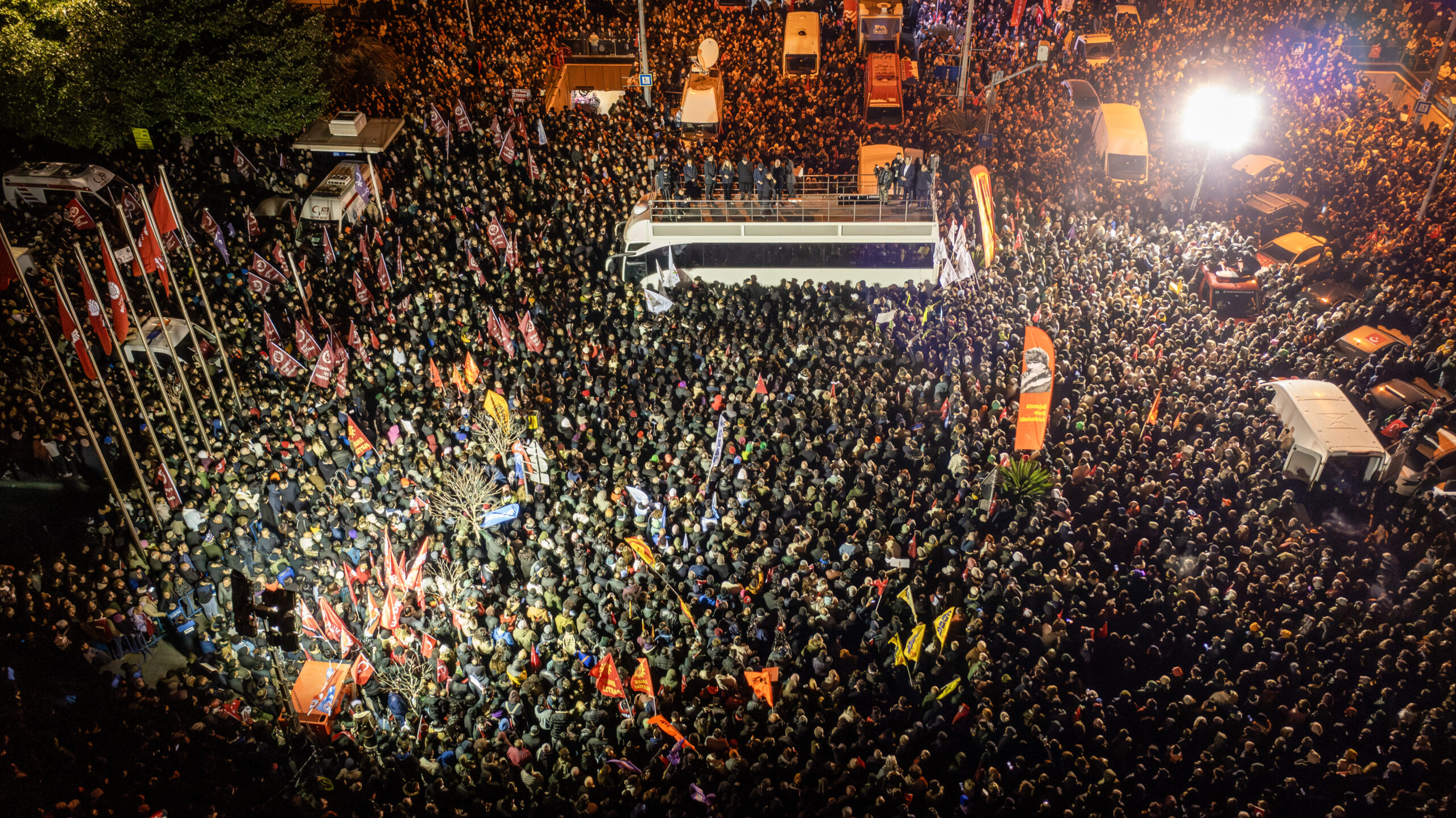
This attitude applies to the CHP’s leadership and grassroots supporters, who are present in the courtroom and vocal both outside and on the streets, as well as to other political parties, civil society organisations, bar associations, journalists, and diplomatic representatives attending the hearings.
Keeping these watchful eyes on the trial is vital for ensuring transparency and holding authorities accountable.
Justice and democracy at stake
Ultimately, what is at stake in the Silivri Prison courtroom extends beyond the fate of İmamoğlu. A trial of this magnitude – marked by sweeping charges, serious concerns about breaches of the right to a fair trial, and restrictions on press access – cannot genuinely deliver justice if it proceeds in ways that obscure rather than illuminate.
When journalists are unable to observe properly, when defence lawyers cannot perform their duties, when defendants lack the necessary means to defend themselves, and when restrictions impede public scrutiny, the courtroom risks becoming less a place for truth and justice than a stage for predetermined outcomes.
Without proper justice in the İmamoğlu case, Türkiye’s democratic future is also at risk. Democracy, in its simplest form, is about the peaceful transfer of power according to popular will.
If that is no longer possible, Türkiye has left the club of democracies. That could be the trial’s true significance.